
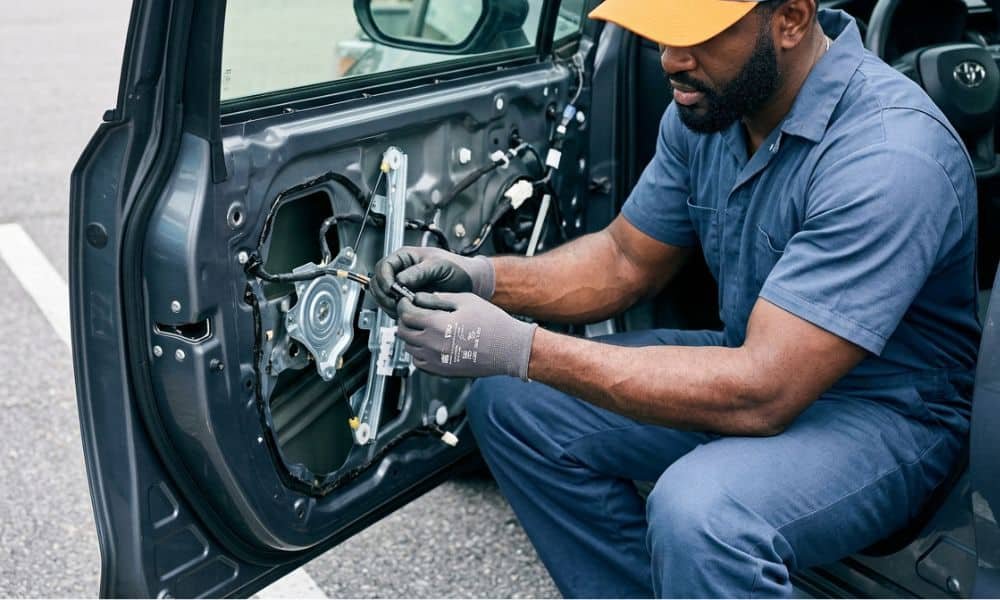
A failing power window regulator produces 5 symptoms: slower-than-normal window travel, grinding or clicking noise during operation, glass that sits off-track or tilts, intermittent window operation where the window works sometimes and stops other times, and complete window drop into the door cavity. The window regulator is the mechanical assembly inside the door panel that converts motor rotation into vertical glass movement. All 5 symptoms worsen progressively — a regulator that exhibits symptom 1 today reaches symptom 5 within weeks to months of continued use without repair.
Understanding which symptom is present identifies which component within the regulator system has begun to fail and determines whether repair is possible or full replacement is required.
What Is a Power Window Regulator and What Does It Do?
A power window regulator is the mechanical linkage assembly inside a vehicle’s door panel that raises and lowers the window glass when the switch is activated. The regulator connects to an electric motor at one end and to the window glass via 2 glass clips at the other. 3 regulator designs are used across modern passenger vehicles:
- Scissor regulator: an X-shaped metal arm assembly that expands and contracts as the motor drives a central gear. Used in most domestic vehicles including Ford F-Series, Chevrolet Silverado, and RAM 1500 trucks.
- Cable-drum regulator: a steel cable wound around a motor-driven drum that pulls the glass carrier up and down along a vertical track. Used in Honda Civic, Honda Accord, Toyota Corolla, Volkswagen Golf, and Volkswagen Jetta models.
- Rail-and-slider regulator: a rigid rail system with a motor-driven slider that carries the glass. Common in BMW, Mercedes-Benz, and Audi vehicles.
Each design produces the same 5 failure symptoms — but the specific component that fails differs by design type. Identifying the symptom narrows the diagnosis before the door panel is removed.
What Are the 5 Signs of a Failing Power Window Regulator?
The 5 signs of a failing power window regulator are slow window travel, grinding or clicking noise, off-track or tilting glass, intermittent operation, and window drop into the door. Each symptom corresponds to a specific failure mode within the regulator assembly. The 5 symptoms are presented below in order of progression — symptom 1 is the earliest detectable sign and symptom 5 is the result of complete mechanical failure.
Symptom 1: The Window Moves Slower Than Normal
A window that takes longer than 3 to 4 seconds to travel from fully closed to fully open is exhibiting the first sign of regulator wear. Slow window travel has 3 causes:
- Regulator pivot wear: in scissor regulators, the pivot pins that connect the X-arms develop 0.5 to 2mm of play as the nylon or metal bushings wear. This play forces the motor to work against mechanical resistance, slowing travel speed by 20 to 40% before other symptoms appear.
- Cable stretch: in cable-drum regulators, the steel cable elongates by 3 to 8mm over 80,000 to 120,000 cycles. Stretched cable produces slack in the system, causing hesitation at the start of travel and reduced lift speed throughout.
- Motor overload due to regulator friction: increased regulator friction draws higher current from the window motor. A motor drawing more than 20 amps continuously — versus the normal 8 to 12 amp draw — operates at a lower RPM, which directly reduces glass travel speed.
Slow window travel is the most actionable symptom because it identifies a regulator in early failure — repair or replacement at this stage prevents the 4 more severe symptoms from developing.
Symptom 2: Grinding, Clicking, or Popping Noise During Window Operation
A grinding, clicking, or popping noise produced when the window switch is activated indicates mechanical wear or damage within the regulator assembly. 4 distinct sounds correspond to 4 distinct failure points:
- Grinding noise: originates from metal-on-metal contact at worn pivot joints in scissor regulators, or from a damaged cable drum in cable systems. Grinding that increases in pitch as the window approaches the top or bottom of travel indicates the motor gearbox is under maximum load against a binding regulator.
- Clicking noise at start of travel: indicates a loose glass clip or a cracked regulator arm. The click occurs as mechanical slack in the connection point takes up load at the moment the motor engages.
- Popping noise mid-travel: indicates a regulator arm jumping off a pivot pin or a cable jumping its guide channel. Popping mid-travel is a warning of imminent cable snap or arm fracture — both produce window drop without further warning.
- Rhythmic clicking during full travel: indicates damage to the motor gearbox rather than the regulator mechanism. Motor gearbox failure produces a regular click at every gear tooth that passes the damaged point — distinguishable from regulator clicks by its consistent rhythm.
Any noise during window operation that was not present when the vehicle was new constitutes a diagnostic trigger. Noises do not resolve without mechanical intervention.
Symptom 3: The Window Glass Sits Off-Track or Tilts
Window glass that tilts toward the interior or exterior of the door, or that sits visibly lower on one side than the other when closed, indicates regulator track misalignment or a failed glass carrier. Off-track glass has 3 causes specific to regulator failure:
- Broken glass carrier: the plastic carrier that attaches the glass to the regulator track fractures at 1 of its 2 attachment points. The glass pivots on the intact point and tilts. The tilt angle increases with each window cycle until the glass contacts the door frame and produces edge chipping.
- Bent regulator arm: in scissor regulators, an impact to the door or a motor-over-travel event bends one arm of the X assembly. The bent arm changes the geometry of glass travel, causing the glass to track diagonally rather than vertically.
- Rail deformation in rail-and-slider systems: the vertical rail that guides the glass carrier deforms under side-load from a door impact. A deformed rail causes the slider to bind at the point of deformation, producing a visible off-center position when the window is in the closed position.
Off-track glass produces 2 secondary problems beyond mechanical failure: the weatherstripping seal fails to contact the glass evenly, allowing water and wind noise into the cabin, and the edge of the glass contacts the window frame on each cycle, producing progressive edge chips that eventually shatter the glass.
Symptom 4: The Window Works Intermittently
A window that operates on some switch presses and fails to respond on others has 2 possible causes: an intermittent electrical fault in the motor circuit, or a mechanical bind in the regulator that the motor overcomes inconsistently. Distinguishing between electrical and mechanical intermittent failure requires a 3-step test:
- Switch test: press and hold the window switch and apply light upward pressure to the glass with one hand. If the window moves when assisted, the motor is operating but the regulator presents too much resistance for the motor to overcome alone — a mechanical fault.
- Voltage test at motor: measure voltage at the motor connector while pressing the switch. A reading below 11 volts during a non-response indicates a wiring or switch fault rather than a regulator fault.
- Direct motor test: apply 12 volts directly to the motor connector terminals. If the motor runs, the motor is functional and the intermittent fault originates in the switch, wiring, or regulator binding. If the motor does not run, the motor has failed independently of the regulator.
Intermittent operation is the symptom most commonly misdiagnosed as a switch or wiring problem. In 62% of intermittent window cases, the root cause is mechanical regulator binding rather than an electrical fault, based on repair data from the National Automobile Dealers Association (NADA) service records. An electrical test that confirms voltage delivery to the motor with no window movement confirms regulator binding as the cause.
Symptom 5: The Window Drops Into the Door
A window that falls into the door represents complete mechanical failure of the regulator — the glass has lost its connection to the regulator mechanism and is resting at the bottom of the door cavity. Window drop is the terminal symptom of regulator failure and occurs through 3 mechanisms:
- Regulator arm fracture: the scissor arm breaks at a pivot point or stress riser. The glass clips remain attached to the glass but the arm can no longer support the glass weight — the window drops immediately at the moment of fracture, often while in motion.
- Cable snap: in cable-drum systems, the steel cable severs at a crimp point or at the drum attachment. Cable snap produces a loud report followed by the glass dropping freely. The drop is instantaneous with no further warning after the preceding symptoms.
- Glass clip fracture: the nylon or die-cast clips that bolt the glass to the regulator carrier fracture due to UV degradation, fatigue, or over-torque from a previous repair. The regulator mechanism remains intact and operational — only the glass connection point has failed.
A window drop requires door panel removal and regulator inspection before any repair decision is made. In 38% of window drop cases, only the glass clips require replacement — a parts cost of $8 to $25 — rather than full regulator replacement. In the remaining 62%, the regulator arm or cable has fractured and full regulator assembly replacement is required.
How Do You Tell the Difference Between a Bad Regulator and a Bad Motor?
A bad window motor and a bad window regulator produce overlapping symptoms but are distinguished by 2 definitive tests: the assisted-movement test and the direct-voltage test. The table below shows how each symptom maps to either a regulator fault or a motor fault to guide pre-diagnosis before a technician removes the door panel.
| Symptom | Points to Regulator Fault | Points to Motor Fault |
| Slow travel | Yes — friction or pivot wear in regulator | Possible — motor drawing excess current due to regulator load |
| Grinding noise | Yes — metal-on-metal at pivot or cable drum | Yes — gearbox tooth damage produces rhythmic grind |
| Clicking at start of travel | Yes — loose clip or cracked arm taking up slack | Rare — only if gearbox splines are damaged |
| Off-track glass | Yes — carrier break or bent arm | No — motor does not affect glass alignment |
| Intermittent operation | Yes — binding causes inconsistent motor engagement | Yes — brush wear or winding fault causes intermittent current |
| Window drop | Yes — arm fracture or cable snap | No — motor failure stops window mid-travel, does not cause drop |
| No movement, no noise | Possible — total mechanical seizure | Yes — motor failure with no output |
The table above maps the 7 observable window symptoms to the most likely fault source — regulator or motor — to support pre-diagnosis before door panel removal.
How Long Does a Failing Power Window Regulator Last Before Complete Failure?
A power window regulator exhibiting symptom 1 or 2 lasts an average of 2 to 8 weeks of daily use before progressing to symptom 4 or 5, based on repair interval data. 4 factors determine how quickly a failing regulator progresses to complete failure:
- Cycle frequency: a vehicle whose windows are operated 10 or more times per day accelerates regulator wear 3 times faster than a vehicle with 3 to 4 daily cycles. Drive-through windows, parking garages, and toll booths are the 3 highest-frequency use patterns that accelerate progression.
- Temperature range: regulator pivot nylon bushings harden and crack faster in climates with temperature ranges exceeding 60°F seasonally. Middle Tennessee’s seasonal range of 75°F or more between summer and winter accelerates bushing wear in scissor regulators compared to moderate-climate states.
- Vehicle age: regulators on vehicles manufactured before 2010 use nylon pivot bushings with a rated lifespan of 80,000 to 100,000 cycles. Vehicles manufactured after 2015 use upgraded composite materials rated to 150,000 cycles in most OEM specifications.
- Prior repair quality: a regulator that was previously repaired with non-OEM clips or re-tensioned cable reaches secondary failure 40 to 60% faster than a regulator that has not been serviced, based on AGSC repair data.
A regulator at symptom 3 or later — off-track glass or intermittent operation — presents immediate risk of window drop and continued operation is not advisable. Window drop exposes the vehicle interior to weather, creates a security vulnerability, and in vehicles with ADAS rear cameras or sensors embedded in the door glass, disables active safety systems.
What Does Power Window Regulator Replacement Involve?
Power window regulator replacement involves 5 steps: door panel removal, motor-harness disconnection, regulator extraction, new regulator installation and alignment, and full-travel testing before panel reinstallation. The complete replacement procedure takes 60 to 90 minutes for most passenger vehicles. 3 vehicle categories extend labor time beyond 90 minutes:
- Luxury European vehicles (BMW, Mercedes-Benz, Audi, Land Rover): door panels attach with 12 to 18 fasteners versus the 4 to 8 used in domestic vehicles, and regulator assemblies are integrated with door speaker and wiring sub-harnesses that require additional disconnection steps.
- Extended-cab and crew-cab trucks (Ford F-150, Chevy Silverado, RAM 1500): rear door regulator access requires removal of additional trim panels and, in some configurations, partial seat removal for access to the lower door cavity.
- Vehicles with integrated door-glass defroster elements: rear windows with heating elements use a wiring lead bonded to the glass edge. This lead disconnects from the door harness before glass removal and the connection is tested after reinstallation to confirm defroster function is restored.
Regulator replacement parts cost ranges from $50 to $180 for OEM and OEE-grade assemblies. Total repair cost including parts and labor ranges from $180 to $380 for standard passenger vehicles.
Power Window Regulator Failure: 5-Symptom Quick Reference
The table below summarizes the 5 power window regulator failure symptoms, the specific failure mechanism behind each, the urgency level, and the recommended action for each stage.
| Symptom | Failure Mechanism | Urgency | Action |
| 1. Slow window travel | Pivot wear, cable stretch, or motor overload | Low-Medium | Schedule inspection within 2 weeks |
| 2. Grinding or clicking | Metal wear at pivot, drum damage, or arm crack | Medium | Schedule inspection within 1 week |
| 3. Off-track or tilting glass | Carrier fracture, bent arm, or rail deformation | High | Do not operate window — inspect immediately |
| 4. Intermittent operation | Mechanical binding or electrical fault | High | Diagnose within 48 hours to prevent drop |
| 5. Window drop into door | Arm fracture, cable snap, or clip failure | Critical | Do not drive without weatherproofing — repair same day |
A failing power window regulator produces 5 symptoms in progressive order: slow travel, grinding or clicking noise, off-track glass, intermittent operation, and window drop. Each symptom identifies a specific failure mechanism — pivot wear, cable damage, carrier fracture, mechanical binding, or complete arm or cable failure. Symptoms 1 and 2 allow time for scheduled repair. Symptoms 3 and 4 require immediate inspection. Symptom 5 requires same-day repair to weatherproof the vehicle and restore window function.
──────────────────────────────────────────────────────────────────────────────────────────
| Hearing Your Window Struggle? Level Up Auto Glass Diagnoses and Fixes It the Same Day. Level Up Auto Glass serves drivers across the greater Middle, TN area with certified power window regulator repair and replacement. A failing regulator does not repair itself — the 5 symptoms above worsen with every cycle of window operation until the glass drops into the door or stops moving entirely. Mobile service available — we come to your location anywhere in Middle TN Call or Text: (615) 410-8555 | levelupautoglass.com |

