
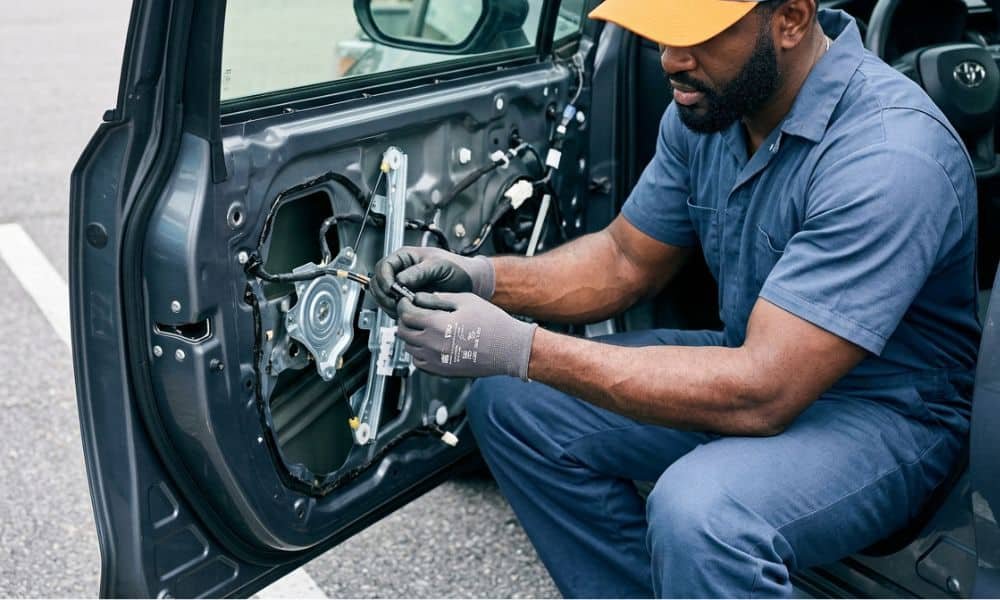
A car window that falls into the door has 1 of 4 causes: a broken window regulator, a failed window motor, a snapped regulator cable, or shattered door glass. The regulator — the mechanical assembly that raises and lowers the glass — is the component responsible in the majority of cases. Diagnosis takes 5 to 15 minutes. Repair time ranges from 45 minutes to 2 hours depending on the component that failed and the vehicle make and model.
What Causes a Car Window to Fall Into the Door?
A car window falls into the door when the mechanical connection between the glass and the window regulator fails. The window regulator is a rack-and-pinion or scissor-lift mechanism housed inside the door panel that converts motor rotation into vertical glass movement. The glass attaches to the regulator via 2 plastic or metal glass clips bolted to the bottom edge of the window. When any point in this system fails, the glass loses its support and drops into the door cavity.
The 4 failure causes that send a window into the door, in order of frequency, are:
- Broken window regulator (most common): the regulator arm or scissor mechanism fractures, most often at a pivot point. The glass clips remain attached to the glass but the regulator can no longer support the weight. The window drops immediately when the fracture occurs, often while the window is in motion.
- Failed window motor: the electric motor that drives the regulator seizes or burns out. In motor failure, the glass does not drop immediately — it stops mid-travel and becomes immovable. If the glass stops partially open and the door is slammed repeatedly, the unsupported glass can shift and fall over time.
- Snapped regulator cable: cable-driven regulators — common in Honda, Toyota, and Volkswagen models — use a steel cable wound around a drum to move the glass. A snapped cable allows the glass to fall freely, often with a loud bang as tension releases.
- Detached or broken glass clips: the 2 bolted clips that connect the glass to the regulator channel are made of nylon or die-cast metal. Age, UV exposure, and repeated vibration cause nylon clips to fracture. The regulator operates normally but the glass is no longer attached to it and falls into the door cavity.
Does the Window Breaking Cause It to Fall Into the Door?
No — a window falling into the door and a window shattering are 2 separate failure events. Door glass is tempered safety glass. When tempered glass fractures, it disintegrates into thousands of small granular pieces rather than falling as a single pane. A window that falls intact into the door has experienced a mechanical failure, not a glass fracture. A window that shatters on impact produces glass fragments throughout the door cavity and on the interior panel — this requires glass removal and door glass replacement in addition to regulator inspection.
How Do You Diagnose Why a Car Window Fell Into the Door?
Diagnosis of a window-into-door failure requires removal of the door panel to inspect the regulator, motor, cable, and glass clips directly. A visual inspection through the window opening is not sufficient — the regulator sits behind the door’s inner steel skin and is not visible without panel removal. A certified auto glass or automotive technician completes this inspection in 5 to 15 minutes.
The 3-step diagnostic process is:
- Door panel removal: the interior door panel attaches with 4 to 8 plastic push-pin clips and 1 to 3 screws concealed behind the door handle and armrest. Removal takes 5 to 10 minutes with standard trim tools and does not damage the panel when done correctly.
- Regulator and motor inspection: the technician visually inspects the regulator for fractured arms, disconnected pivot points, and cable integrity. The motor is tested with a direct 12-volt application to determine whether it operates independently of the switch circuit.
- Glass clip inspection: the bottom edge of the glass is examined for detached or fractured clips. Broken clips are identifiable by the absence of a mounting point on the regulator channel where the clip previously seated.
Can You Tell What Failed Without Removing the Door Panel?
3 symptoms before the window drops indicate which component failed, without panel removal. These symptoms are not definitive — panel removal is required for confirmed diagnosis — but they narrow the likely cause:
| Symptom Before Drop | Likely Failed Component | Certainty Without Panel Removal |
| Window moved normally then dropped suddenly mid-travel | Regulator arm fracture or cable snap | Moderate — 70% of cases with this symptom |
| Window stopped moving, then fell later after door slamming | Motor failure with secondary clip fatigue | Low — requires electrical test to confirm motor |
| Grinding or popping sound before drop | Cable drum failure or regulator pivot failure | Moderate — cable and pivot failures produce audible precursors |
| Window fell without any prior symptom | Glass clip fracture | High — sudden silent drop with functional motor points to clip failure |
The table above shows 4 pre-failure symptoms, the most likely failed component for each, and the diagnostic certainty achievable before door panel removal.
How Do You Fix a Car Window That Fell Into the Door?
The fix for a window that fell into the door is determined by which of the 4 components failed. In all cases, the door panel is removed first, the glass is carefully lifted out of the door cavity, and the failed component is replaced before the glass is reinstalled. The 4 repair paths are:
Repair Path 1: Broken Window Regulator
A broken window regulator requires full regulator assembly replacement. Regulators are not repaired — fractured arms and failed pivot points are not field-serviceable. Replacement regulators are available as OEM parts from the vehicle manufacturer or as OEE (Original Equipment Equivalent) aftermarket units. The regulator replacement process involves:
- Disconnecting the motor wiring harness from the regulator
- Removing the 4 to 6 mounting bolts that secure the regulator to the door’s inner skin
- Extracting the old regulator from the door cavity through the access opening
- Installing the new regulator, securing all mounting bolts to the manufacturer’s torque specification
- Reconnecting the motor harness and testing window travel through full up and down cycles before panel reinstallation
Regulator replacement takes 60 to 90 minutes for most passenger vehicles. Labor time increases to 2 hours or more for vehicles with complex door assemblies, including most Land Rover, BMW, and Mercedes-Benz models.
Repair Path 2: Failed Window Motor
A failed window motor is replaced as a standalone component or as a motor-regulator assembly. Many manufacturers supply the motor and regulator as a combined unit — in these cases, both are replaced together even if only the motor failed. Standalone motor replacement is available for vehicles where the motor bolts separately to the regulator body. Motor replacement takes 45 to 75 minutes and includes an electrical test of the switch, wiring, and fuse circuit before the door panel is reinstalled, to rule out secondary electrical causes.
Repair Path 3: Snapped Regulator Cable
A snapped cable requires replacement of the cable-drum regulator assembly. Cable-driven regulators — common in Honda Civic, Honda Accord, Toyota Corolla, Volkswagen Golf, and Volkswagen Jetta — have the cable wound on a plastic or aluminum drum. When the cable snaps, the drum and cable are replaced as a unit with the regulator body. Individual cable replacement is not standard practice because the cable end fittings are factory-crimped and re-crimping in the field does not restore original tensile strength. Cable-drum regulator replacement takes 60 to 90 minutes.
Repair Path 4: Broken Glass Clips
Broken glass clips are the lowest-cost repair path — the glass and regulator are undamaged. Replacement glass clips are available for most vehicles as a set of 2 for $8 to $25 in parts cost. The clips bolt to the bottom edge of the glass, the glass is lowered onto the regulator channel, the clips are tightened to the correct torque, and window travel is tested before panel reinstallation. Total repair time is 30 to 45 minutes in most vehicles. Nylon clips are replaced with OEM-specification nylon or upgraded metal clips depending on the vehicle’s factory specification.
What Happens if the Door Glass Broke When the Window Fell?
Shattered door glass requires complete removal of all glass fragments from the door cavity before any regulator or clip work begins. Tempered glass fragments inside a door cavity number in the hundreds and collect in the bottom of the door, in the weatherstripping channels, and behind the inner steel skin. Incomplete fragment removal causes 3 ongoing problems: fragments embed in the new window’s run channel and cause scratching, fragments contact the regulator mechanism and cause accelerated wear, and fragments work into the door’s drainage holes and block water evacuation.
Complete door glass failure requires 2 repair operations performed in sequence:
- Glass extraction and cavity cleaning: all fragments are removed from the door cavity using a vacuum and compressed air. The run channels, weatherstripping, and regulator are inspected for embedded fragments before any new glass is installed. This step takes 20 to 40 minutes depending on fragment density.
- Door glass replacement: a new tempered door glass panel is sourced by vehicle year, make, model, and door position. The glass is installed into the run channels, attached to the regulator via new clips, and tested through full travel before the door panel is reinstalled.
Door glass replacement adds 30 to 60 minutes to the total repair time and requires sourcing the correct glass unit, which is specific to the vehicle’s year, make, model, door position (front vs. rear, driver vs. passenger), and whether the vehicle has a manual or power window system.
How Much Does It Cost to Fix a Window That Fell Into the Door?
Total repair cost for a window that fell into the door ranges from $80 to $450 depending on the failed component, vehicle make, and whether the glass shattered. The 4 cost ranges by repair type are:
| Failed Component | Parts Cost | Labor (est.) | Total Range |
| Glass clips only | $8 – $25 | 30–45 min | $80 – $150 |
| Window motor only | $40 – $120 | 45–75 min | $150 – $280 |
| Regulator assembly | $50 – $180 | 60–90 min | $180 – $380 |
| Cable-drum regulator | $60 – $160 | 60–90 min | $180 – $360 |
| Regulator + shattered door glass | $130 – $280 | 90–150 min | $280 – $450+ |
Cost estimates above reflect average parts and labor costs for standard passenger vehicles in the United States as of 2025. Luxury vehicles, trucks with complex door assemblies, and vehicles requiring OEM-only parts fall at or above the upper range.
Does Insurance Cover a Window That Fell Into the Door?
Comprehensive auto insurance covers door glass replacement when the glass shatters due to a covered event — not mechanical failure of the regulator or motor. A window that falls into the door due to a broken regulator is a mechanical failure, which falls under the vehicle’s extended warranty or service contract rather than auto insurance. A window that shatters as a result of a covered event — vandalism, a falling object, or a road hazard — is covered under comprehensive coverage subject to the policy’s deductible. Drivers with a zero-deductible glass endorsement pay nothing out of pocket for door glass replacement in a covered event.
Is There a Temporary Fix for a Window Stuck Inside the Door?
Yes — 1 temporary measure keeps the door weatherproof while the repair is scheduled: heavy-duty clear plastic sheeting secured with automotive masking tape across the window opening. This measure is weatherproof for 24 to 72 hours in dry conditions and is not a substitute for repair. 3 actions accelerate damage and are avoided during a temporary fix period:
- Do not slam the door — door slamming shifts the glass inside the cavity and can cause the glass to contact the regulator mechanism, creating edge chips or cracks that complicate reinstallation
- Do not operate the window switch — running the motor with the glass disengaged from the regulator causes the motor and cable drum to run without load, which accelerates motor wear and can snap a partially intact cable
- Do not leave the window unprotected overnight in rain — water entering the door cavity pools in the bottom of the door and accelerates corrosion of the regulator mechanism and motor housing
Is a Window-Into-Door Repair a DIY Job or a Professional Job?
Window regulator repair and door glass repair is achievable as a DIY repair for 2 of the 4 failure types: glass clip replacement and standalone motor replacement. Regulator replacement and cable-drum replacement require more precise component alignment to ensure the glass travels without binding, tilting, or contacting the run channel walls. Misaligned regulators produce 3 secondary problems after DIY installation: glass that binds in the upper channel and chips at the top edge, glass that tilts toward the door exterior and fails to seal against the weatherstripping, and motor overload caused by the regulator running against resistance.
The 4 repair types ranked by DIY difficulty:
- Glass clip replacement — Low difficulty: requires trim tools, a socket set, and torque wrench. No alignment adjustment is required.
- Motor replacement (separate motor) — Moderate difficulty: requires electrical testing knowledge to confirm the motor is the fault and not the switch or wiring.
- Regulator replacement — High difficulty: requires regulator alignment within the door cavity before bolting. Misalignment by more than 2mm causes glass travel issues.
- Cable-drum regulator replacement — High difficulty: cable tension must be set correctly during installation. Incorrect tension causes cable re-snap within 6 to 12 months of repair.
A car window that falls into the door is repaired by identifying the failed component — regulator, motor, cable, or clip — removing the door panel, replacing the failed part, and reinstalling the glass. Total repair time is 30 minutes to 2 hours. Total cost ranges from $80 to $450. Shattering of the door glass adds a glass replacement step and increases total cost by $100 to $180. A temporary plastic-sheet weatherproof cover is the correct short-term measure while the repair is scheduled. Regulator and cable-drum replacements carry a higher DIY difficulty rating and are most reliably completed by a certified auto glass or automotive technician.
Car Window Fell Into the Door? Level Up Auto Glass Fixes It the Same Day.
Level Up Auto Glass serves drivers across Murfreesboro, & the greater Middle, Tennessee region. Our technicians diagnose whether your door glass failure is a broken regulator, a failed motor, or a cable snap — and complete the repair or replacement the same day in most cases.
3 reasons Middle Tennessee drivers choose Level Up Auto Glass:
- Mobile service available — we come to your location in Murfreesboro and surrounding areas
- Most insurance claims handled directly — zero out-of-pocket for covered repairs
- OEM-quality replacement glass and regulator components with a written warranty
Call or Text: (615) 410-8555 | levelupautoglass.com

